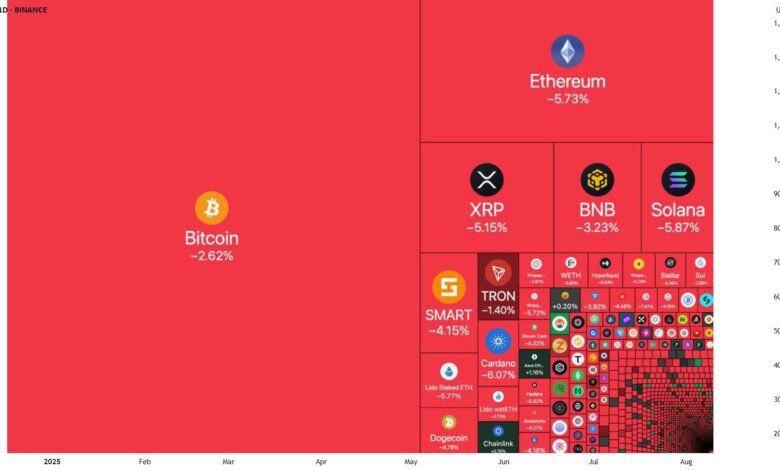
The recent downturn erased over half a trillion dollars from the cryptocurrency ecosystem in less than a month. Market analysts describe the event as a broad-based correction rather than an isolated Bitcoin decline. Nearly every major crypto sector experienced heavy losses as investors reduced positions and liquidations accelerated across derivatives markets.
Reports indicate that Bitcoin alone lost more than $400 billion in market value during the correction, making it the primary driver behind the overall decline. As Bitcoin weakened, confidence across the broader market deteriorated, leading to additional selling pressure in Ethereum, Solana, XRP, and numerous smaller cryptocurrencies.
Bitcoin Leads the Sell-Off
Bitcoin remains the largest cryptocurrency by market capitalization, and its movements heavily influence the entire digital asset industry. During the latest market correction, Bitcoin dropped toward the $61,000 level, reaching its lowest prices in months. The decline triggered substantial liquidations of leveraged positions, forcing traders to sell assets at a loss and amplifying downward momentum.
Several factors contributed to Bitcoin’s weakness:
- Significant outflows from spot Bitcoin ETFs.
- Reduced institutional demand.
- Investor rotation toward artificial intelligence (AI) stocks and upcoming technology IPOs.
- Concerns regarding global economic conditions and interest rates.
- Increased geopolitical uncertainty.
Market analysts noted that Bitcoin experienced one of its weakest yearly performances in more than a decade, with investor attention increasingly shifting toward other high-growth sectors.
Massive Liquidations Accelerate Market Decline
One of the most damaging aspects of the correction was the surge in leveraged liquidations. As prices fell, traders using borrowed funds were forced to close positions automatically.
According to market data cited by KuCoin, crypto liquidations exceeded $1.2 billion within a single day, while broader market reports estimated liquidations approaching $1.77 billion during the recent sell-off period.
When leveraged positions are liquidated, exchanges automatically sell holdings to cover losses. This creates a cascading effect:
- Bitcoin falls.
- Leveraged positions are liquidated.
- Forced selling increases.
- Prices decline further.
- Additional liquidations occur.
This feedback loop contributed significantly to the rapid destruction of market value across the crypto ecosystem.
Institutional Investors Pull Back
Institutional investors played a major role in the downturn. Several Bitcoin exchange-traded funds (ETFs) experienced substantial outflows as investors withdrew capital from crypto-focused products.
Reports show that Bitcoin ETFs recorded billions of dollars in net outflows during recent weeks. Some funds experienced their longest streak of redemptions since launch, highlighting a notable decline in investor confidence.
At the same time, capital flowed into alternative investment opportunities, particularly AI-related companies and anticipated public offerings from major technology firms. This shift reduced demand for Bitcoin and other digital assets.
Impact on Altcoins
While Bitcoin led the decline, altcoins generally suffered even larger percentage losses.
Historically, altcoins tend to outperform Bitcoin during bullish periods but underperform during market corrections. As Bitcoin weakened, investors moved toward cash and stable assets, causing heavier losses among smaller cryptocurrencies.
Several sectors experienced significant declines:
- Meme coins
- AI-related crypto projects
- DeFi tokens
- Gaming tokens
- Layer-1 blockchain assets
The broad-based nature of the sell-off demonstrated how interconnected the cryptocurrency market remains despite increasing diversification across sectors.
Macroeconomic and Geopolitical Pressures
The crypto market correction did not occur in isolation. Global economic conditions contributed heavily to investor caution.
Key concerns included:
- Higher interest rates.
- Inflation uncertainty.
- Geopolitical tensions.
- Slower economic growth expectations.
- Reduced appetite for speculative investments.
Bitcoin and cryptocurrencies are often categorized as risk assets. During periods of uncertainty, investors frequently move funds into safer investments, reducing demand for digital assets. This trend became increasingly visible during the recent correction.
Is This a Bear Market?
The major question facing investors is whether the recent decline marks the beginning of a prolonged bear market or simply a healthy correction within a larger bullish cycle.
Some analysts argue that the sell-off reflects normal market behavior following a period of strong gains. Others believe the crypto industry may face additional downside pressure if institutional demand remains weak and ETF outflows continue.
Despite short-term weakness, many market participants continue to monitor:
- On-chain activity.
- Institutional adoption.
- Regulatory developments.
- ETF flows.
- Global liquidity conditions.
These factors will likely determine the direction of Bitcoin and the broader crypto market during the coming months.
Outlook for the Crypto Market
Although the loss of $500 billion in market value appears alarming, large corrections have historically been a recurring feature of cryptocurrency markets. Previous cycles have seen similarly dramatic declines followed by substantial recoveries.
The current environment remains challenging, but long-term investors are closely watching support levels, institutional participation, and regulatory developments for signs of stabilization. Bitcoin’s ability to regain momentum will likely determine whether the crypto market can recover from this correction and resume its broader growth trend.
Conclusion
The recent crypto market correction erased more than $500 billion in value within 25 days, making it one of the most significant sell-offs of 2026. Bitcoin was the primary driver of the decline, losing hundreds of billions in market capitalization and triggering widespread liquidations across the industry. ETF outflows, macroeconomic uncertainty, geopolitical risks, and shifting investor preferences toward AI-related investments all contributed to the downturn. While short-term sentiment remains cautious, investors continue to monitor key market indicators to determine whether this event represents a temporary correction or the beginning of a deeper bear market.